Scale Is the Subject
Samyaza Speaks, Obliteration, and the real-world anchors that let the impossible be measured
By Avery Lane | Mon, Nov 23, 2026
The sublime has a measurement problem. Show a viewer a structure the size of a mountain range and, with nothing beside it, the eye files it as a model on a tabletop. Painters have known this for centuries, which is why the tiny figure on the cliff edge keeps turning up in the corner of the canvas. You need the small thing to feel the big thing.
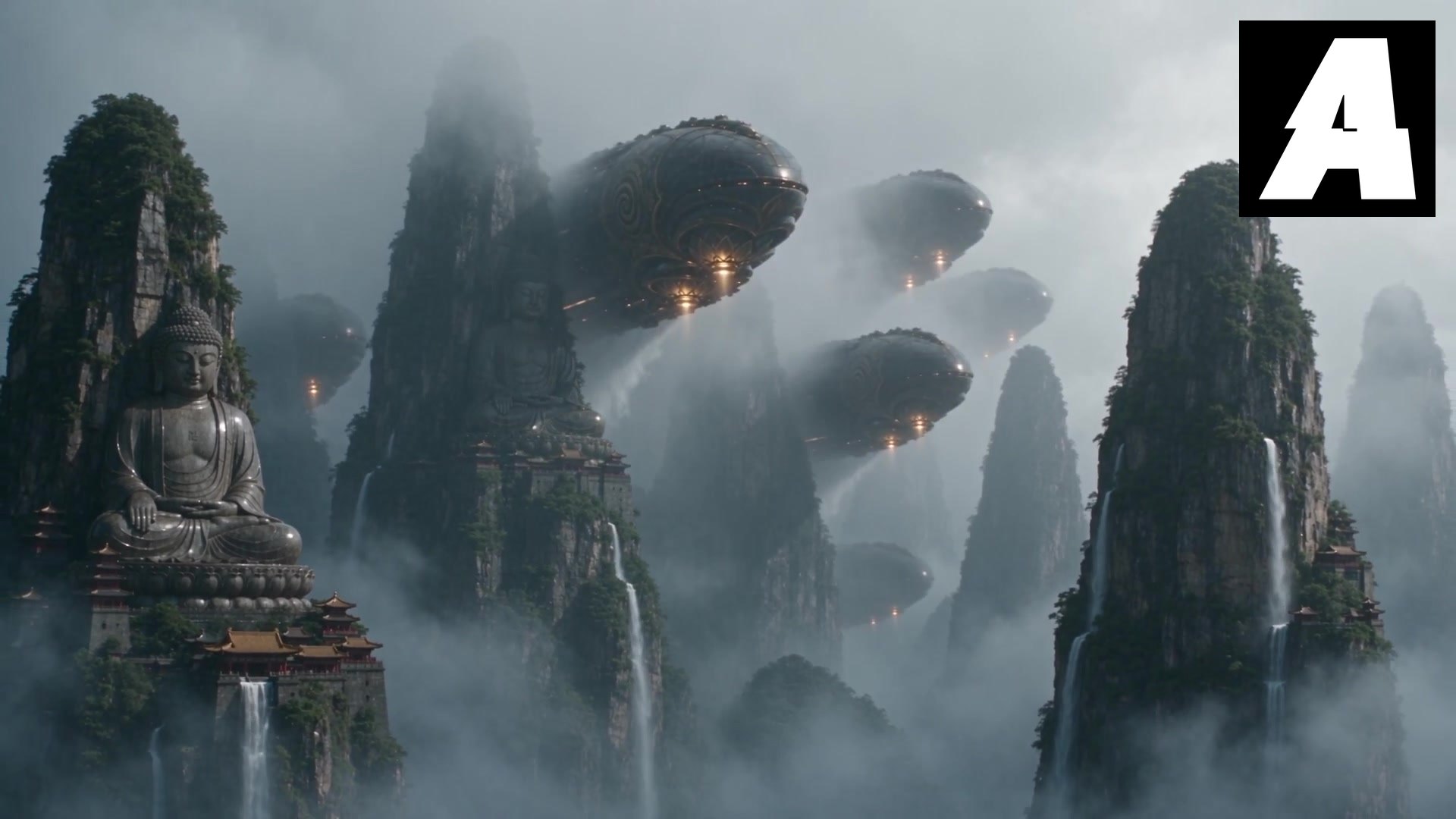
Obliteration, a five-minute film by Samyaza Speaks, is built on that rule. It stages the impossible (Buddhist megastructures, orbs hanging in the air, the apocalyptic erasure of Notre Dame and the Statue of Liberty) and then keeps handing you something real to hold it against. The mundane and the monumental are there as rulers. Scale is the real subject.
Obliteration
— Samyaza Speaks (@SamyazaSpeaks) October 30, 2026
Made with @VeniceAI
Language: Pali
The post went up on October 30 with a caption of three lines: the title, “Made with @VeniceAI,” and “Language: Pali.” By November 23 it showed more than 1.2 million views, over 10,000 likes and more than 7,300 bookmarks. That last number is the one I trust. People bookmark what they intend to come back and study.
The ruler in the frame
The trick in Obliteration is restraint about what gets to be fantastic. The megastructures are not floating in a void; they share the frame with things whose size you already carry in your body. Notre Dame and the Statue of Liberty are the obvious cases, because almost everyone has a sense of how big they are, which is exactly why their erasure lands. When the known thing goes, the unknown thing finally has a size.
That is a painter’s decision, not a software feature. A model will render a colossus all day long. What it won’t do on its own is insist that the colossus stand next to a cathedral so the cathedral can tell you how tall it is.
Architecture as a visual system
The second thing worth noticing is how the film treats myth. The mythic architecture here is not illustration, a picture hung beside a story to explain it. It works as a visual system: repeated forms, a grammar of domes, rings and orbs that the film keeps returning to until you read it like a language. It ends on a classical profile logo, which is the film quietly telling you it thinks of itself as a body of work with a mark, not a one-off clip.
The language on the soundtrack is part of the same system. The film runs in Pali, the language of the Pali Canon. Asked about it in the replies, he explained that the sect in his head is “using Pali liturgically. It’s not their native language. These are like zealot post humans that use Pali the way the Catholics use Latin.” The look of the figures, he wrote in another reply, “was inspired by Buddhist art which has a sort of unclear ethnic look.”
How it was made
Here is the mechanism, plainly. He generated the shots as short video clips on Venice, a platform that puts a range of commercial video models behind one login, and assembled them into a five-minute film. Asked what he used, he answered: “I used mostly Seedance 2.5. It is hugely flexible. It is a Chinese model that can be accessed through Runway, Venice, Higgsfield etc.”
The starting point was older than any of those tools. A few days after release he posted a single image with the line “This painting inspired Obliteration btw.” His own description of the process comes back to the same idea: classical painting brought into motion, doing what wasn’t possible before AI. [VERIFY QUOTE WITH ARTIST]
Myth with no production constraints
Obliteration is not his first trip to this material. The Biblical Experience, which we already feature on his artist page, and The Indo-European Experience both treat mythology as raw material. What the tools change is the budget. There is no set to build, no location to clear, no studio to tell you a Himalayan cult’s temple is too expensive. The constraint that used to decide which myths got filmed is gone, and what’s left is taste.
The persona is the distribution layer
Then there is the account itself. The bio reads, in full, “Neo-Darwinian Aristotelian BioJihadist with Chinese Characteristics.” It is a provocation built to make you stop scrolling, and it works as the wrapper around films that treat religious forms as pure visual grammar. The persona gets you to the post. The film is what keeps you there.
What comes next
He has already said where he’s going. Episode 2 was announced on November 11 as “Coming Soon. Made with @VeniceAI. This time in 4k.” Earlier he told followers to “expect human characters. Expect action. Expect revelations of this dark cult and how following the peaceful Dharma led them to this contradictory path of ruination.” More recently he said it “is gonna be more low key. Less action, more characters.”
The lesson for anyone making work at this scale is the one the first film already teaches. If you want the impossible to feel enormous, give the viewer a ruler. Put something real in the frame.
The studio light stays on. If this piece made you want to see the next one, subscribe at artevolves.com or send it to another maker who still cares about the scar where the hand met the material.
AdSense/Ad Spot Placeholder