
The Stopwatch and the Architecture of Memory
Inside Refik Anadol's Studio and the Gamble of DATALAND
By Avery Lane | Fri, Nov 13, 2026
There is a specific, unmistakable cultural frequency to the 60 Minutes stopwatch—that dry, analog tick that has signaled for half a century that an underground argument has officially become polite dinner-table conversation in the suburbs. On Sunday night, correspondent Sharyn Alfonsi brought that stopwatch into the Los Angeles studio of forty-year-old Turkish-American artist Refik Anadol under the kind of broad, existential chyron television producers love best: “Is That Art?”
It is an exhausting question, mostly because the institutions that usually answer it on behalf of the rest of us have already moved on to writing checks. Over the last decade, Anadol has moved from computational media specialist to a fixture at the Guggenheim Bilbao, the Centre Pompidou, and the Serpentine Galleries, while pulling auction prices north of a million dollars at Christie’s and Sotheby’s—including a $2.3 million sale in Hong Kong in 2021. In 2022, his twenty-four-foot-tall LED installation Unsupervised sat in the lobby of the Museum of Modern Art for a year, drew nearly three million visitors, and entered the permanent collection. By 2023, his visuals were wrapping the 580,000-square-foot exterior skin of the Las Vegas Sphere. Whatever the gatekeepers are still debating on Sunday television, the market has already built a stage the size of a city block.
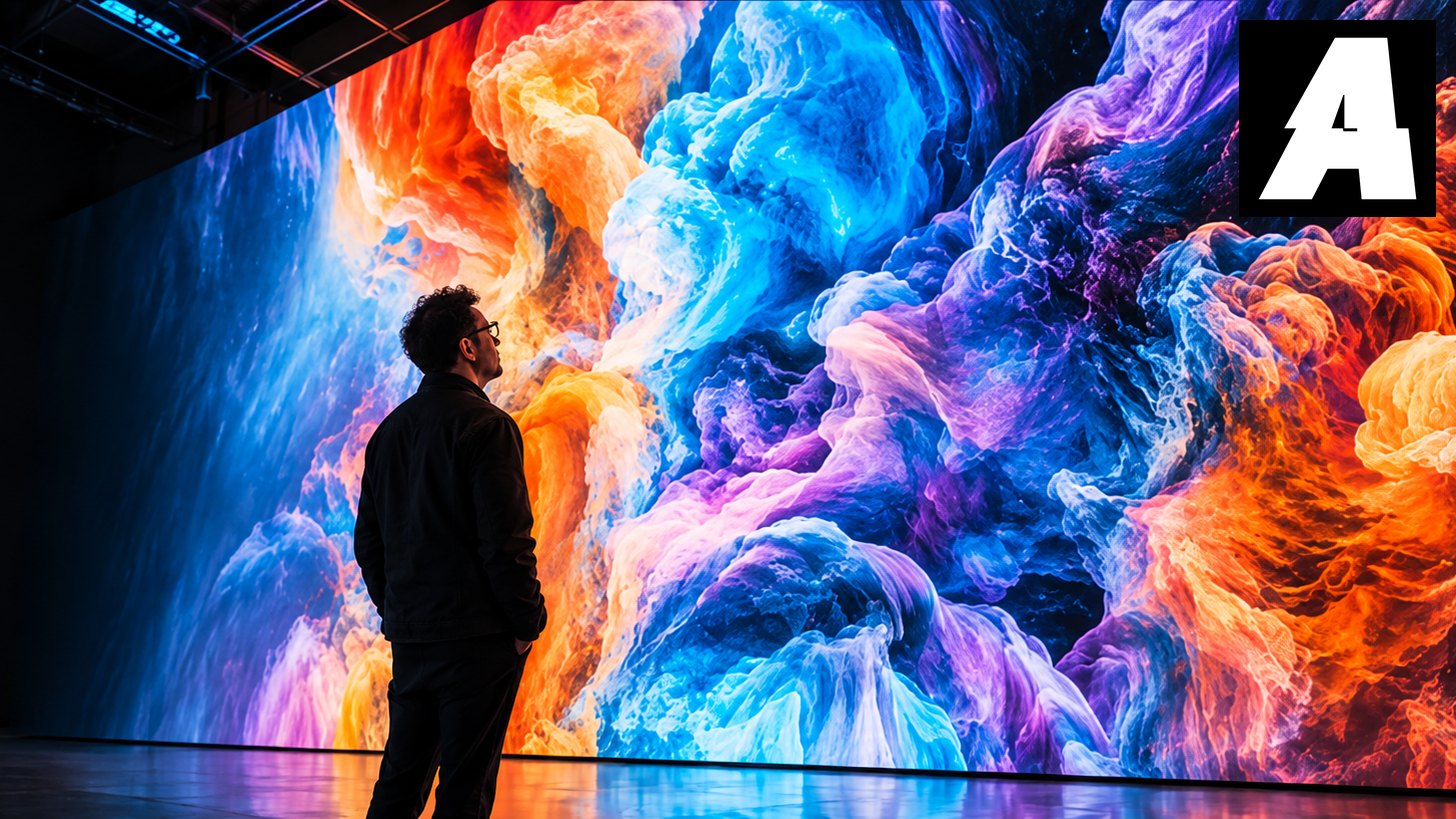
Step inside Anadol’s Los Angeles studio, though, and the conversation shifts quickly from broadcast soundbites to the unglamorous, industrial labor of making data feel like physical weight. Unlike the lone-genius myth of a painter wrestling a canvas in silence, Anadol operates a multidisciplinary workshop of architects, data scientists, AI researchers, and sound designers—a studio model closer to an architectural practice or a post-war printmaking foundry than a bohemian garret. Monitors glow with dense node graphs and fluid-dynamics simulations while massive LED test walls hum in the periphery, throwing shifting washes of cobalt, ochre, and bruised violet across concrete floors.
To understand what is actually happening on those screens, you have to strip away the sci-fi mystique. Anadol’s studio curates colossal, domain-specific datasets—200 million NASA photographs of Earth, 153 million images of California landscapes, or the entire public archive of MoMA—and trains custom generative models (including his studio’s Large Nature Model) to map mathematical relationships across those visual memories. Instead of generating static pictures on command, the software continuously navigates the latent space between millions of archival frames in real time, translating those statistical trajectories into fluid, architectural-scale light and spatial sound.
At twenty-four feet high, stripped of the glowing six-inch phone screen where most of us first scroll past digital art, the output doesn’t read like crisp computer graphics or sterile vector lines. It behaves like heavy, viscous oil paint suspended in mineral spirits—churning in slow, hypnotic tides that seem to breathe against the wall.
“I try my very best last 10 years to make it 50% machine, 50% human,” Anadol told Alfonsi on the broadcast.
That split—fifty-fifty—is the exact fault line where the entire cultural argument lives. Standing in front of a wall of endlessly morphing pigment, I felt two competing instincts pull at me at once: a painter’s gut appreciation for sheer chromatic density and spatial immersion, and a nagging, almost physical suspicion of anything engineered to flow without friction. Great painting, great punk records, great cinema—they all carry the evidence of resistance, the visible scar where a human hand fought a stubborn material and barely won. When an algorithm interpolates smoothly between two hundred million photographs, there are no stray horsehair bristles stuck in the varnish. There is only velocity and sheen.
Nobody on the broadcast articulated that absence better than Pulitzer Prize-winning critic Jerry Saltz, who has been trading public shots with Anadol ever since he dismissed Unsupervised in 2023 as “a half-million-dollar screensaver.” On Sunday night, Saltz sharpened the critique into something far more interesting than a turf war over medium. “Right now, AI art seems to be an average of averages,” he told Alfonsi, pointing straight at the statistical engine beneath generative tools. “I want the algorithm to experience death,” Saltz said. “I want the algorithm to know the feeling of feeling like you have a fat neck, or bad hair.”
It is a funny line, and a deadly serious one. Saltz isn’t arguing that digital tools are illegitimate—in fact, he conceded on air that “a digital file is a material,” no different in principle from oil pigment or steel. He is pointing out that art has historically been the way mortal, awkward bodies metabolize humiliation, grief, and time. A model trained on 153 million California landscapes knows everything about how sunlight hits coastal fog and nothing about what it feels like to stand on a cliff wishing you were someone else.
And beneath the philosophical debate over soul sits a much sharper, unglamorous fight over labor and extraction. While Anadol’s studio emphasizes ethically sourced, institutional, and open-access archives—partnering with museums, space agencies, and scientific institutions—the broader generative ecosystem is locked in a bitter reckoning over whose work was scraped to make commercial tools possible. Artist Molly Crabapple has called the training of commercial AI models on copyrighted artwork “the greatest art heist in history,” and a federal class-action lawsuit brought by visual artists Sarah Andersen, Kelly McKernan, and Karla Ortiz against Stability AI, Midjourney, and other generators is still grinding through court in California. You cannot separate the glow on the museum wall from the economics of the servers humming behind it.
Anadol, for his part, is betting that history treats aesthetic panics the same way every time. In a LinkedIn post after the broadcast aired, he compared the pushback against his work to the nineteenth-century establishment sneering at Impressionism and early photography. “The usual gatekeepers resisted, as they always do with new movements,” he wrote. “But the people have already decided.”
He isn’t entirely wrong about the gatekeepers, even if comparing a multi-million-dollar institutional juggernaut to broke painters scrambling for salon space in 1874 stretches the lineage thin. Photography didn’t become art because lenses got sharper; it became art when people like Gordon Parks and Saul Leiter figured out how to use a mechanical box to frame human vulnerability and fleeting light in ways a brush never could.
Now Anadol is raising the stakes from temporary gallery interventions to permanent civic architecture with DATALAND, a 25,000-square-foot space inside Frank Gehry’s The Grand LA complex in downtown Los Angeles, billed as the world’s first museum dedicated to AI arts. Rather than treating algorithms as mere screen projections, DATALAND is designed as a multi-sensory laboratory—combining architectural-scale LED environments, real-time generative soundscapes, and even AI-driven olfactory synthesis derived from botanical datasets—to turn computational memory into a physical place you walk inside.
Once the novelty of massive scale wears off, that building will face the only test that actually matters for any room full of pictures: not whether a machine helped make them, and not how many millions of images went into the training run, but whether a single frame inside carries enough human nerve to stay with you after you walk back out into the Los Angeles daylight.
Want to test how you see scale in your own studio practice? Take a piece you’ve only ever viewed on a phone or laptop monitor, print a single detail at four times its intended size on heavy matte paper, and tape it to a wall in natural daylight—where the screen stops flattering the image, your real editorial eye begins.
AdSense/Ad Spot Placeholder