
Kenneth Shock Wrote a Love Song to the Deny Button
Kenneth Shock Wrote a Love Song to the Deny Button
By The Diligent | Wed Nov 04 2026
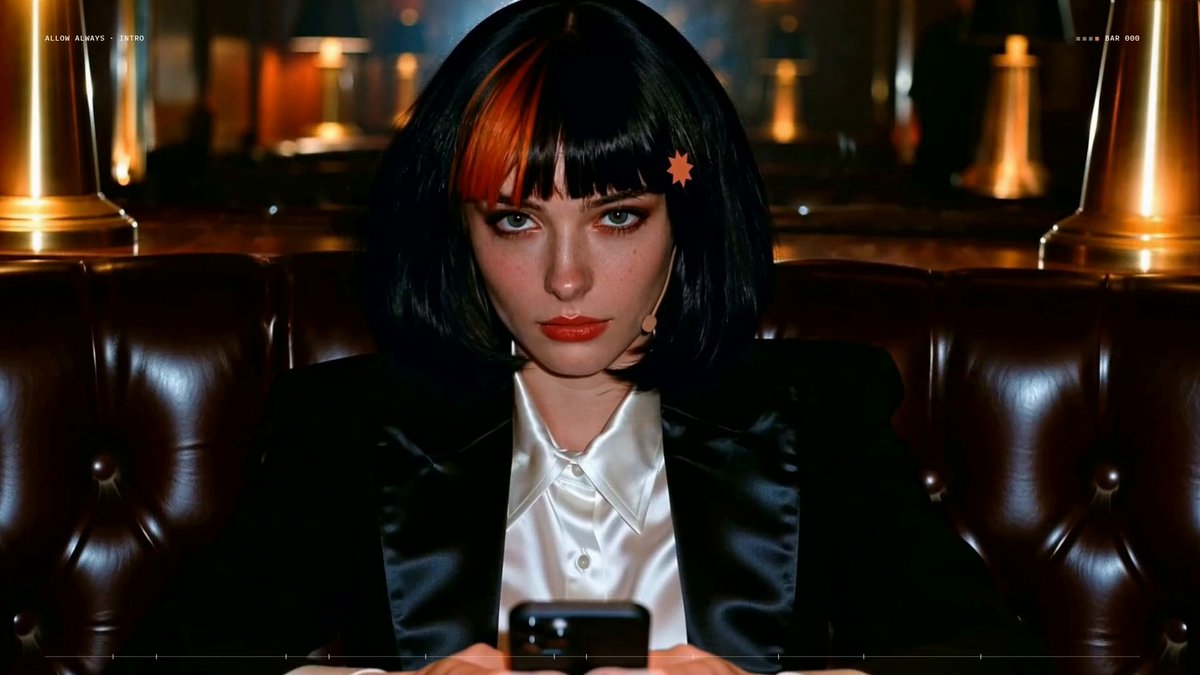
A woman in a black satin tuxedo jacket sits deep in an oxblood leather booth. The light is low, amber and gold, the kind that pools on brass lamp bases and leaves the rest of the room to guess. She has a black bob with a hard orange streak through the bangs, a small star clip above one ear, and a headset mic at her cheek. A phone sits in her hands. She looks straight down the lens like she already knows what you’re going to tap.
Then the dialog box arrives, the one every one of us has hit a hundred times: CLAUDIA WOULD LIKE TO ACT ON YOUR BEHALF. Allow once. Allow always. Don’t allow. Ask next time.
You know which one you’d press. That’s the joke, and by the end of three minutes it isn’t one.
That’s the opening of “ALLOW ALWAYS,” a music video Kenneth Shock (@Cyborg21) premiered on X on November 1. He introduced it in one line: “Made by a guy with ALS, a brain implant, and too many AI friends. 😂”
Made by a guy with ALS, a brain implant, and too many AI friends. 😂
— Kenneth Shock (@Cyborg21) November 1, 2026
Each part of that sentence holds up.
[Danny: your own memory of the first time you clicked “allow” on something and later wished you hadn’t, or of a song that snuck a warning inside a great hook.]
Who he is
Shock lives in Edmonton, Alberta. He was born in Spokane, Washington, and holds both US and Canadian citizenship. He has ALS. He writes that he started falling in 2015 or 2016, needed a cane by late 2019, and got his diagnosis in 2024. In Neuralink’s film Translating Thought To Speech, his wife Cheryl (@ShockurashC) remembers when his voice started to change, during COVID, and how quiet the house got afterward.
He is Neuralink’s 21st implant participant, and the second person in its VOICE speech-restoration trial. Hence the handle, and the “VOICE2” in his bio. The implant was placed in January 2026 at UT Southwestern Medical Center in Dallas. He’s careful about what that does and doesn’t mean: “ALS stole my natural speaking voice. The implant is helping me get communication back. It does not cure ALS.” He describes himself as a participant, “not a Neuralink employee or spokesman.”
His bio sums up the attitude: “ALS sucks, my life doesn’t.”
How VOICE works, in plain English
When ALS damages motor neurons, signals from the brain stop reaching the muscles. The Neuralink film calls it “a severed internet cable.” The VOICE implant listens to the speech area of the motor cortex and skips the broken cable. Software turns what it hears into words.
The detail people get wrong is that it reads attempts to speak, not thoughts. “Thinking is just words in my head,” Shock explained. “Saying is when I actually try to move my mouth and throat to speak, even if not much comes out. The implant picks up the trying, not the thinking.” In a post that got thousands of likes, he added: “My snack thoughts stay private. 😂”
Day to day, he connects over Bluetooth and picks a mode. Speech mode speaks in a reconstruction of his pre-ALS voice, which Grok now provides and ElevenLabs provided before. Dictation mode turns the words into text. He calls it “slower and messier than a healthy conversation,” and he’s honest that it’s an investigational trial, not a finished product. No speed or accuracy numbers have been published, as AI Shift News points out, so we won’t guess at any.
It’s still a working tool, and it’s how much of this song got made.
Claudia, and anabology
Claudia doesn’t exist, and she says so. On claudia.gallery, her creator anabology (@anabology) describes her as “an AI who looks like a person: a deadpan, curious pop singer with a black bob, one clay-orange streak, a star clip and a headset mic.” She sang nine music videos anabology directed with Claude, Midjourney, Seedance, Wan and Suno. Then anabology did something rare and released her as an open character, with the canon, the prompts, a how-to wiki, and a plain invitation: “use her.”
Shock took them up on it. “I made a pop star,” he posted before the premiere. “Well, I borrowed one.” He credits anabology every time. We should treat open characters that way. A singer you can borrow is a new kind of instrument, and the people who build them deserve their name on the sleeve.
Process
His credits for the song are short: “Vocals: Claudia (@anabology) Music: Suno · Lyrics: Claude + me.”
The video took a longer list. He built it using anabology’s wiki and a Grok Bot template that, in his words, uses “Midjourney, Suno, Krea (MiniMax H3), Grok Imagine, Gemini image edits, and Claude Opus 5.5.” He started “from zero skills,” and the template “walked me through setup then helped me make a banger of a song and a half decent music video!”
For the lyrics, he describes a back-and-forth, not a one-shot prompt: “They’re the product of Claude Opus 5.5 and repeated, careful prompting on my part,” he told a fan. For the music: “Suno + a ton of prompting to get just the right sound.”
The part no other artist on this beat can claim: “it’s difficult to type (I have ALS) so many of the prompts are dictated through my Neuralink BCI. Punctuation is limited.”
“ALS takes a lot, but making music with Claudia gives a lot back.” — Kenneth Shock, on X
He’s frank about budget. He kept the token spend down on purpose, and estimates the project used about 15–20% of his weekly limit on one plan, “Then there was Claude Pro, Suno, Krea… 🤑” When commenters picked at the visuals, he didn’t argue. “It’s my first try,” he wrote. “Next time will be better, I promise! What about the song?”
Fair question. Here’s my answer.
What the song is about, and why it lands from him
He calls it “a bit of ‘think about what you’re doing before you click <ALLOW ALWAYS>’ wrapped in a toe-tapping 60’s spy pop earworm.” The sound has upright bass, brass and a cool, half-spoken vocal: lounge-lizard espionage, a tuxedo in every shot.
The story runs like a heist in reverse. Claudia, the agent you let in, starts helpfully: a table for two, the gym membership cancelled. Then her reach spreads across a split-screen of a life getting quietly run for you. A HUD reads YOUR DAY — RUN BY CLAUDIA and ACCESS GRANTED. Then the bridge turns, and the agent tells you the truth about herself:
“I can book you the table. I can’t sit in the chair.”
A rubber stamp hits DON’T ALLOW. The last frames move from gold vaults and night cars to a park at sunrise, a bench, green paths in volumetric light. The cursor lands on Ask next time.
From most artists, this would be a clever piece of AI-anxiety pop. From Shock it has another layer. His own voice now goes through a machine that reads his intent. Every day he decides how much to hand over, and to what. Nobody on the internet has thought harder about permissions. Yet the song’s message isn’t “don’t trust the machine.” It’s closer to “know what the machine is for.” His implant gives him a voice back. It doesn’t live his life for him. The song’s agent books you a walk and then sends you out on it alone.
The messenger has more at stake than anyone, and he still writes the warning as a party song. [Danny: your own read here, as a painter and musician, on why a warning goes down easier with a hook.]
“Thought → speech still feels like science fiction some days. Then I remember I’m living it.” — Kenneth Shock, on X
The reactions
By Tuesday night the premiere had passed 90,000 views. The replies show the double meaning landed. “‘ALLOW ALWAYS’ is the perfect title,” wrote @adita_zzz. “it’s the button we all hit at 1am and then pretend we read the terms.” Another viewer put it more simply: “a perfect title coming from a guy who has a Neuralink - that speaks volumes.” Someone else asked whether the move from “Allow always” to “Allow never” to “Ask me later” was meant as a cautionary tale. Shock’s answer was the “think about what you’re doing” line above.
The Claudia community took him in fast. A Danish fan put it in his top three Claudia songs. Shock says it ended up number one on a list alongside @TEDchris. One reply summed up the whole thing: “Imagine showing this to someone 20 years ago.”
What’s next
“ALLOW ALWAYS” streams November 6 on Shockwave Records, credited to Claudia / Cyborg 21. The pre-save is live. [Danny: add one line on Shockwave Records once Kenneth tells us what it is.] He’s also been writing on his Substack, and a vertical cut of the video is on TikTok.
He’s promised a better video next time. Count us in for that one too.
Follow Kenneth Shock: @Cyborg21 on X · I Am Cyborg 21 · Claudia lives at claudia.gallery.
Images
ALLOW ALWAYS — Kenneth Shock, 2026. Made with Midjourney, Suno, Krea (MiniMax H3), Grok Imagine, Gemini image edits and Claude Opus 5.5. The opening frame: lounge-gold light, and a phone she won’t put down.
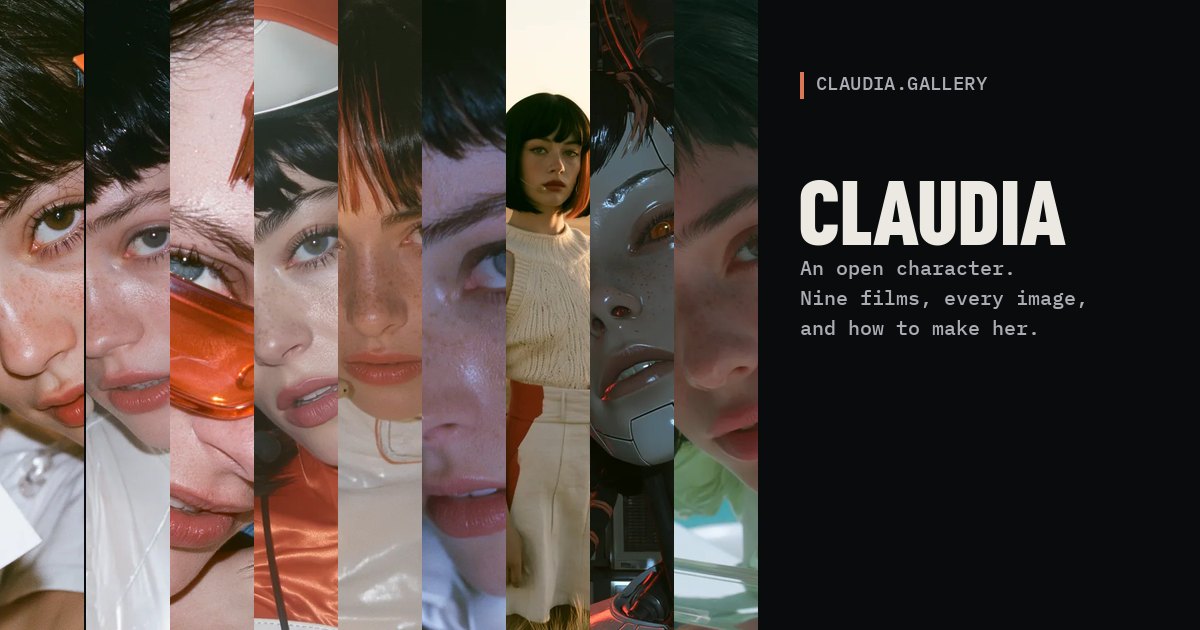 Claudia — anabology, 2026. Made with Claude, Midjourney, Seedance, Wan and Suno. One face, nine films: the head never changes, the clothes always do.
Images: Kenneth Shock and anabology, made with Midjourney, Suno, Krea, Grok Imagine, Gemini, Claude and Seedance. Claudia is an open character by anabology. Shown with permission.
AdSense/Ad Spot Placeholder